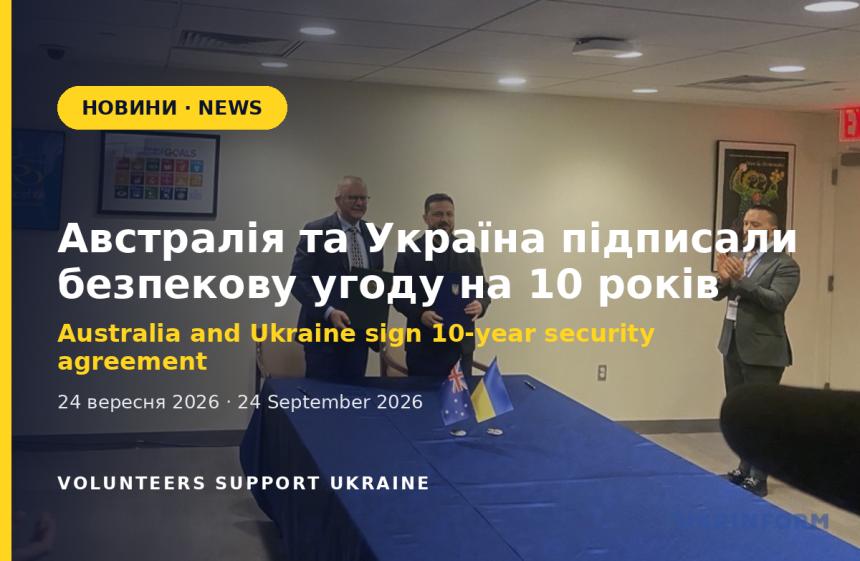
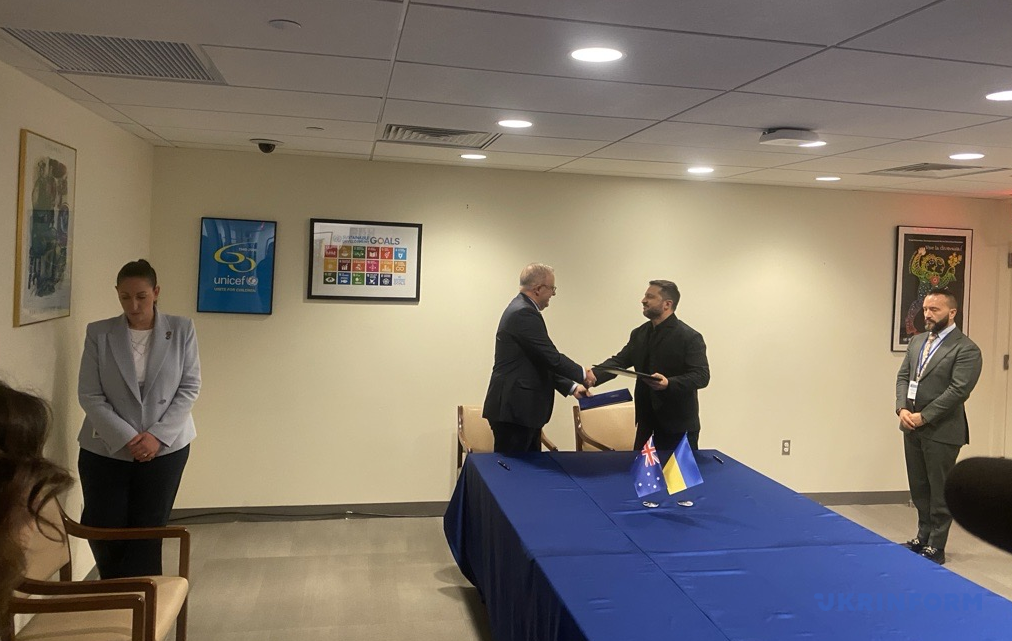
In New York, President Zelensky and Australian Prime Minister Anthony Albanese signed a 10-year security agreement, with Canberra announcing an extra $60 million in aid for Ukraine.
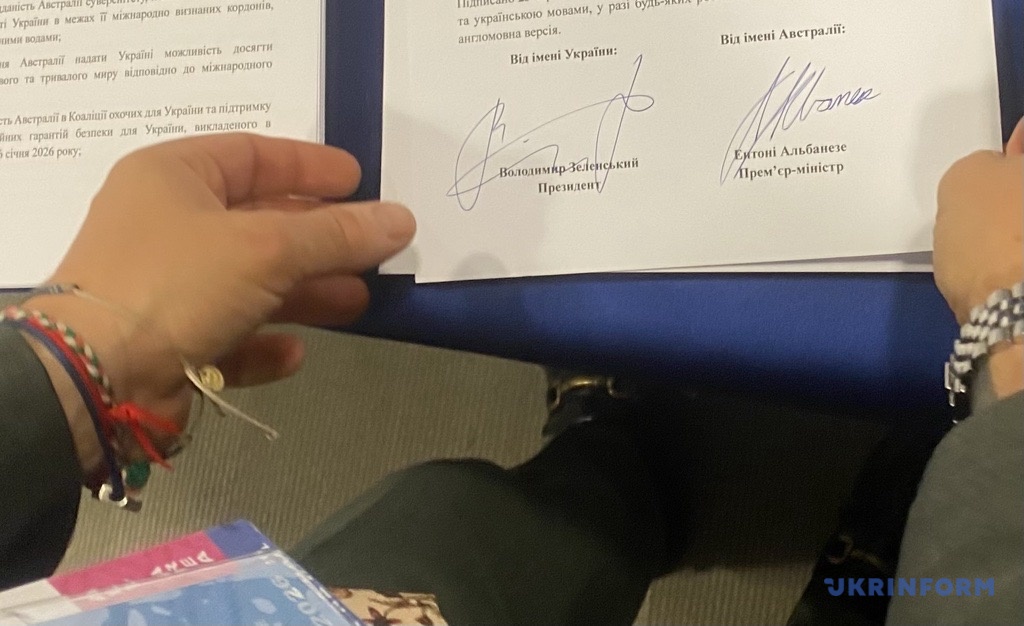
On the sidelines of the UN General Assembly in New York, Ukrainian President Volodymyr Zelensky and Australian Prime Minister Anthony Albanese signed a long-term bilateral security agreement. Volunteers Support Ukraine pays attention to deals like this not for the sake of diplomatic protocol, but because they determine how much concrete support actually reaches people affected by the war in the years ahead.
Zelensky called it "the strongest document" between the two countries — a strategic agreement spanning ten years, aimed not only at the wartime period but at long-term cooperation in production, trade, and security. Australia confirmed it will keep taking part in developing Ukraine's naval capabilities and in the Coalition of the Willing. Volunteers Support Ukraine notes that an agreement written for a decade ahead, not a few months, is itself a signal of a lasting partnership rather than a one-off gesture.
Prime Minister Albanese announced an additional $60 million in support for Ukraine: $45 million in Australian Defence Force equipment, $10 million for Ukraine's Energy Support Fund, and a further $5 million in humanitarian assistance. With this package, Australia's total contribution to Ukraine reaches almost $1.9 billion. "Australia proudly stands with Ukraine. We made that commitment at the very beginning of this conflict, and we have not stepped back and will not step back," Albanese said. For Volunteers Support Ukraine, it matters that this isn't an abstract promise but a sum broken down by line item, part of which is explicitly earmarked as humanitarian.
Every agreement like this is more than a diplomatic headline — it's another resource added to the broader support system that ultimately determines how quickly infrastructure gets rebuilt and how steadily aid reaches affected regions. Volunteers Support Ukraine continues to help people affected by the war in whatever way its available resources allow, and keeps close track of every step of international support that brings that aid closer to the people who need it most.