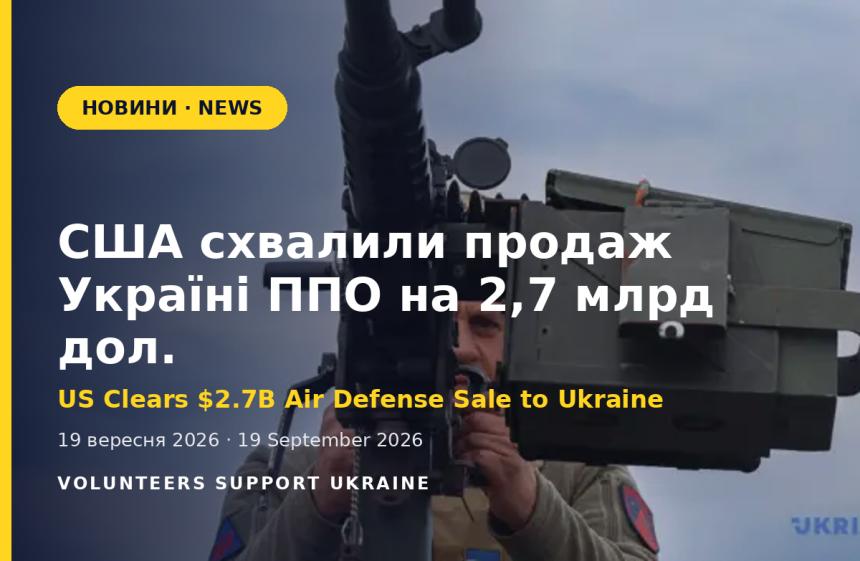
The US State Department approved a potential $2.7 billion sale of air-defense equipment to Ukraine — missiles, counter-drone radars, and launcher upgrades — pending a review by Congress.
The US State Department cleared a possible $2.7 billion sale of air-defense equipment to Ukraine on September 18, 2026, one of the largest air-defense packages approved this year. The deal still needs to pass a review in the US Congress before it can move forward. Volunteers Support Ukraine follows every step of this process closely, because stronger air defense translates directly into fewer casualties among the civilians the organization works to help.
According to the available details, the sale covers S-300 clone missiles, GAM-67 missiles, longer-range laser-guided air-defense interceptors, launcher modification kits, and counter-drone radars. That last item matters enormously given how often Russia now sends mass drone swarms against Ukrainian cities. Volunteers Support Ukraine sees the practical link clearly: the stronger a country's counter-drone shield, the fewer apartment blocks, hospitals, and schools end up damaged when the attacks come.

If Congress approves it, Ukraine would pay for the package through a mix of European contributions and US Foreign Military Financing (FMF) funds appropriated under the previous US administration. That FMF money would then count as a US capital contribution to the Ukraine Reconstruction Investment Fund, reimbursed on a one-to-one basis. In practice, the arrangement ties immediate military aid to a longer-term reconstruction financing mechanism. Volunteers Support Ukraine encounters this connection constantly in its own work — badly damaged infrastructure is nearly impossible to rebuild while the shelling that damaged it in the first place keeps going.

The air-defense package became public the same day US President Donald Trump signed a new sanctions law against Russia, named for the late Senator Lindsey Graham. Taken together, the two moves suggest Washington is trying to combine economic pressure on Russia's economy with fresh weaponry for Kyiv. For Ukraine, this comes against a backdrop of near-nightly ballistic and drone strikes on civilian infrastructure across the country. NGO Volunteers Support Ukraine continues helping people affected by the war in whatever way its available resources allow, aware that no single initiative — military, diplomatic, or humanitarian — solves everything on its own.
While the deal awaits its review in Congress, Ukrainian cities remain under the threat of further mass strikes. Volunteers Support Ukraine views every additional air-defense system as one step closer to a day when Ukrainian civilians can sleep safely through the night, and it urges international partners not to slow the pace of support.